


Super Deformed


In Japan, you'd be hard-pressed to find a popular franchise that didn't receive its own line of Keshi figures in the 1980s. Keshi (ケシ), also known as keshigomu (ケシゴム), literally translates to "eraser rubber" and is a colloquial term for small toys made from colorful, eraser-like rubber. Meanwhile, Super Deformation (SD) is a popular Japanese artistic style that depicts characters in an exaggerated, short, and often chubby form. These two elements would inevitably coalesce during the height of Beastformers' popularity, giving rise to the Beastformers Super Deformed!

Fig. 1
Beastformers SD were small rubber figures that were available in three colors: red, blue, and green (fig. 1). The twenty different SD figures are represented in the gallery below.
These tiny 1" figures came with a weapon, which was attached to the figure by a small strip of rubber. (fig. 2)
Although the figures and weapons were stamped with their own unique numbers, the number on the figure did not match the number on the attached weapon (fig. 3). In true Takara fashion, kids were expected to collect multiple figures in order to match each beast with its appropriate weapon. In fact, SD figures had their own mini-game, and the odds of winning increased when a beast was paired with its corresponding weapon! We'll discuss the rules of the game shortly, but for now let's take a look at how SD figures were offered to Japanese consumers.


Fig. 2
Fig. 3
"Look for Miracle Victory Power (MVP) Weapons! The weapon with the matching number of a Super Deformed Beast is that figure’s MVP weapon! When a Super Deformed Beast gets its MVP weapon, it becomes more powerful. You will want to look for those!"
SD figures were sold in the following three ways:
-
Gachapon capsule machines
(1987-1988)
Like the "gumball" Gachapon Beastformers, these SD figures were packaged in small plastic capsules (fig. 4) and sold in vending machines throughout Japan. They included an attached weapon, a heat-sensitive Battle Emblem, and a small paper insert (fig. 5).
-
Takara candy boxes
(1988-1990)
These SD were sold by Takara and were packaged in a white box (fig. 6) that contained candy.
-
Meiji cookie boxes
(1988)
In 1988, the popular Japanese candy company Meiji collaborated with Takara and released SD figures in stunning gold candy boxes (fig. 7). In addition to the SD figures themselves, the boxes included detailed rules for various mini-games (fig. 8).


The panel to the left highlights the various uses of an SD figure (fig. 9). The top portion explains the rock-paper-scissors game we all know and love. However, as we move further down the panel, things become a lot more interesting!
Perhaps the most bizarre component illustrated in this panel is the "SD bowling" game. When translated, the panel explains that a thin layer of super glue can be applied to the bottom of an SD figure, reducing friction, and allowing it to slide across a smooth surface. Why on earth would we want to do this, you ask? SD bowling, of course! Although it is not featured on this particular panel, the illustration below (fig. 10) depicts an SD White Leo being slid into two other SD beasts!
Lastly, the panel shows that SD beasts can be turned into keychains by running a chain through their weapon holes (fig. 11)!

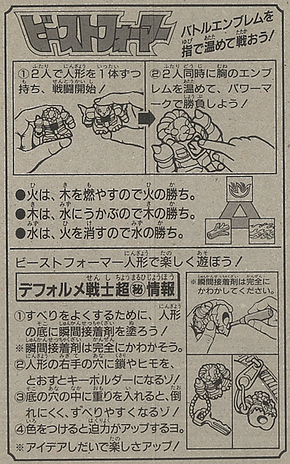
Fig. 4
Fig. 7
Fig. 8
Fig. 6
Fig. 5
Fig. 9

Fig. 10


