


Pre-Production and Prototypes
Each and every one of our favorite figures has a unique story of how it came to be. More often than not, these stories are truncated, shrouded in mystery, or completely unknown. Still, every once in a great while, the universe throws us a boon, and another page is added to the story!
In addition to their immense collectible value, prototypes and other pre-production materials are fantastic tools that allow collectors to fill in the gaps between early concepts and finished retail products. Because toy companies never intended for their early drafts to reach the retail market, prototypes are often extremely rare and hard to come by. This was particularly true for Takara, which was extremely protective of its intellectual property. Simply put, most early concepts for its toys never made it beyond factory walls. Those that did, however, often sat quietly in the private collections of former Hasbro employees, only to surface periodically on the secondary market.
The following is a collection of figures, photographs, transparencies, promotional materials, and other pre-production items that have surfaced over the years. Although many of these pieces raise more questions than answers, collectively they provide critical insight into the development process of this amazing toy line!
Series One Wax Castings
Long before Battle Beasts found their way into toy aisles and collections around the world, they began life as humble wax castings. These remarkable pieces are essentially the common ancestors of every Battle Beast we have ever known or loved. Cast directly from the original hand-sculpted masters created by Takara's immensely talented sculptors, they represent the very first physical interpretation of these iconic figures before they were refined into retail toys.
Wax castings served a vital role in the manufacturing process. Once the original master sculpt was complete, wax copies were used to produce the production molds that would eventually brings countless figures to store shelves around the world! In essence, every figure—whether it be a Battle Beast, a Beastformer, or a Laser Beast—can be traced back to wax castings like these.
Because they capture the sculptors work before the pressures of mass production, wax sculpts offer a fascinating glimpse into the genesis of the Battle Beasts/Beastformers toy line. They represent the moment when a spark of creativity first became something tangible—the bridge between imagination and the iconic figures that inspired the vary words you're reading!

Courtesy of Dabbuu
Perhaps the most fascinating aspect of these wax castings is seeing just how much changed before the figures reached store shelves. While some beasts made the journey to production virtually untouched, others underwent dramatic redesigns. From entirely different weapons to altered proportions and even abandoned color schemes, these early castings offer a fascinating look at the evolution of the Battle Beasts/Beastformers line. Let's take a closer look at each beast to see how its design evolved from early concept to final retail form.
Also, I would like to extend a huge thanks to Dabbuu and the rest of the Beastformers Archeology team for being the pioneers on this topic. Without photo contributions from Dabbuu and the analysis from the Beastformers Blog, this section of the website would not be possible. I have, in essence, simply reiterated their findings into a format that suits my own project.
Blitzkrieg Bat:
This figure's wax sculpt immediately stands out because of its enormous wings. Much larger than those found on the retail figure, they give our beloved bat a far more imposing appearance! Even more intriguing is its weapon, which in this case is a savage-looking spiked club that never made it into production for any Battle Beast.


Rocky Rhino:
The most noticeable difference with Rocky Rhino is impossible to miss: its horn. The wax sculpt features a dramatically larger horn that gives the beast an even more intimidating appearance!


Sledgehammer Elephant:
This figure experienced several interesting refinements before reaching store shelves. The hammer attached to its right arm is mounted vertically on the wax sculpt instead of horizontally as seen on the retail figure. Moreover, its trunk also hangs off to one side rather than extending straight downward, while the tusks are noticeably larger and more pronounced. Perhaps the biggest change, however, is the figure's weapon. Rather than wielding the familiar club-lance, Elehammer, the wax sculpt wields an early version of Oakron, Roamin' Buffalo's weapon.


Horny Toad:
This figure undoubtedly has the most eyebrow-raising name in the entire lineup, but its early concept was surprisingly tame—nothing too far from the little green, red, and yellow fellow that we all know and love. The only readily noticeable difference is that the shoulder spines appear to be slightly blunted on the wax sculpt. Other than that, it would appear that Takara really toad the line on this one!


Colonel Bird:
This figure's wax sculpt features fins projecting from the sides of its helmet that were completely removed before production. It also carries Bomb Sabeler, Triple Threat Snake's axe— another example of how Takara was shuffling around weapons throughout the design process.


Ferocious Tiger:
This is another beast that remained largely unchanged. The biggest difference can be found in its mace, whose spikes are far sharper and more pronounced than those on the production version. As with many toy early toy designs, these sharper details were likely softened for safety reasons.


Grizzly Bear:
Unlike many of the other wax sculpts, Grizzly Bear made the transition to retail with virtually no changes. Its proportions, details, and weapon remained remarkably faithful to the original design, making it one of the closest matches between prototype and production.


Triple Threat Snake:
This figure is particularly exciting because it is one of only three painted wax sculpts known to exist. This allows us to see an entirely different color scheme from the one ultimately chosen for retail production. Even better are its wonderfully awkward fangs, which are individually painted and appear much longer than those on the production figure. They give our beloved Triple Threat Snake an almost comical expression that was scrapped before release, and that's probably for the best!


Deer Stalker:
Much like the aforementioned Triple Threat Snake, Deer Stalker survives as one of the painted wax sculpts, offering another glimpse into an abandoned color palette. Its weapon is equally fascinating, appearing to be an early, hiltless variation of Killer Carp's weapon rather than the accessory eventually included with the retail figure. Small details like these provide valuable clues about how both character designs and weapons evolved together.


Pirate Lion:
Ironically, the most iconic and recognizable figure in the entire Battle Beasts line up may be the least recognizable when compared to its retail counterpart. Not because of the changes to the sculpt itself, but because of its striking color scheme. The wax sculpt for Pirate Lion, a figure we all know and love, features a unique color scheme that may not be so unfamiliar if we really think about it. If you feel a sense of familiarity when looking at these photos, it's probably because you've seen these colors before! The painted wax cast matches the early color scheme seen in concept artwork for Pirate Lion, including promotional artwork found on the Battle Beasts lunchbox. In addition to this alternative color palette, the wax sculpt wields Colonel Bird's weapon instead of the iconic White Beamer and features a set of white spikes at the base of each wrist bracer.


White Leo Prototype Chromes
The following six photographs offer a glimpse into an alternate reality where our iconic White Leo (Pirate Lion) may have appeared with an entirely different color scheme! With his beige base-color and striking yellow accents, it begs the question whether or not this early test shot version of White Leo would have commanded the same degree of brand recognition as his commercially-released counterpart. Furthermore, we can see from these prototype chromes that this figure may have been planned to release with Fly Kick's (Colonel Bird) weapon instead of his iconic White Beamer great sword—blasphemy! Finally, and perhaps more subtly, we can see that the sculpt for this figure's arms are entirely different, with two spikes on the wrist bracers, instead of one.

Describe your image

Describe your image

Describe your image
Describe your image
All photos in this gallery are courtesy of Radpopjunkie
The X-Sell Chromes
For nearly 40 years, these transparent chromes sat in the desk drawer of a former CLS&M partner, just waiting for their chance to illuminate some of the most shadowy corners of the Battle Beasts toy line. CLS&M was the New York City–based design firm responsible for creating many of the packaging graphics for Hasbro in the 1980s. These photos were taken in 1988 for an American company called X-Sell Promotional Material.

Describe your image

Describe your image

Describe your image
Describe your image
As many of us know, aside from the lower 12 “Shadow Warriors,” Laser Beasts were not widely distributed outside of Japan and a few select European countries. That’s what makes these chromes so special; they’re tangible proof that Hasbro had plans to release the Battle Chariots and other Japanese-exclusive beasts into the American market! So what happened? We still don’t know; however, what we do know is that the mythical Beast Eater prototype actually exists, and not only that, there are two distinct variants (fig. 1-2)!

Fig. 1
Back in 2012, a peculiar eBay listing appeared: an unassembled prototype box for the never-released Battle Beasts: Beast Eaters (fig. 3). This cardboard sheet featured artwork depicting a gruesome creature named Swamp Smasher. The monstrosity in the image was covered in thick green scales, dorsal spines, horns, and rows of sharp teeth. A very unlucky Sailon Shadow Warrior was trapped in its jaws, while a raccoon “Crystal Creature” rode on its back.
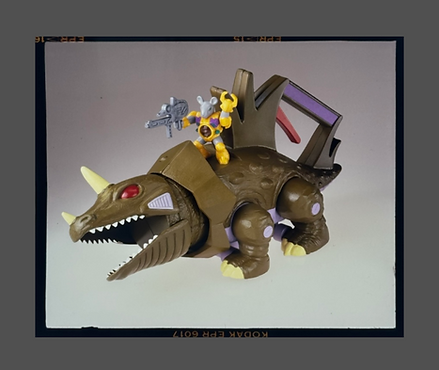
Fig. 2
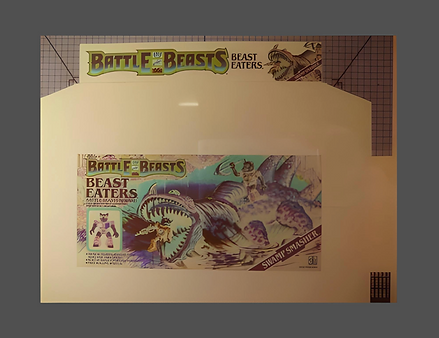
Fig. 3
Courtesy of Shadow Bat
We can deduce from the appearance of the raccoon, which features a Laser Beast orb instead of a standard Battle Beasts heat-sensitive battle emblem, that this may have been a novel concept that never saw the light of day. On the lower left-hand corner of the box, we see the following descriptive features:
-
Hand-activated feature pops out head and jaws open!
-
Built-in handle for easy portability!
-
Free-rolling wheels!
When we consider these features while looking at the Swamp Smasher chrome (fig. 4), it becomes abundantly clear that the monstrosity in the photograph is indeed the Beast Eater prototype! Moreover, the chrome itself lends credence to the legitimacy of the Beast Eaters box! After all these years, we finally have both pieces of the puzzle, and we can confidently say that Hasbro came very close to arming our Beasts with ridable Beast Eaters!

Fig. 4
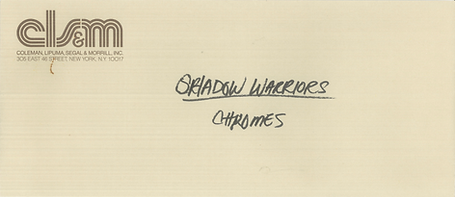
Moreover, the following envelopes were included in this listing, and hand-written on them, are the names of each type of transparency.


The Moll Listings and the Albino Zebra
In May of 2024, several listings appeared on eBay, all from the same seller, all claiming to originate from a mysterious "former Hasbro employee." The item description was the same for all thirty-two listings, and was as follows:
"This listing is one of a special collection from [NAME REDACTED], a long time toy product manager at Revell and Hasbro in the 1970s and 1980s. Among these listings are mint boxed production items as well as some rare prototypes, production catalogs and other publications. Please be sure to examine each item carefully for variations from publicly released items as I am sure I will miss some unique variations in these listings that will make for a nice find for an advanced collector."
SPECIAL NOTE: Marcia was the Assistant Product Manager in charge of the Battle Beasts line and flew to Japan to review the line and put together the product catalog and other promotional items. She brought this figure and the other BB figures listed back from that visit to Japan. She can't positively verify it, but she believes that the figures listed here this week are from the photo shoot that was used to put together the sales catalog and other promo materials for the US market."

We've been waiting for this for years—PROTOTYPES! —Killer Carp
Aside from four Zealot Zebras, most of the figures from these listings seemed to be unremarkable, Series Two beasts; however, thanks to my eagle-eyed friend, Killer Carp, we were able to identity several unique qualities among these figures and bring them home! We'll take a closer look at the Zealot Zebra figure in a moment, but for now, let's see why these Series Two Beasts are truly special! The five figures below are all from the same group of eBay listings that came from the Marcia Moll collection.


When compared to standard figures, the Series Two beasts from these listings all share one remarkable feature: weapons that are not only visibly brighter, but are also missing the numeric stamp that binds them to their corresponding figures! Although The photos on the right (fig. 1) clearly showcases this phenomenon, they don't explain why it is unique to this handful of beasts. Let's do some more digging!

Fig. 1

1
2
3
4
5
Fig. 2
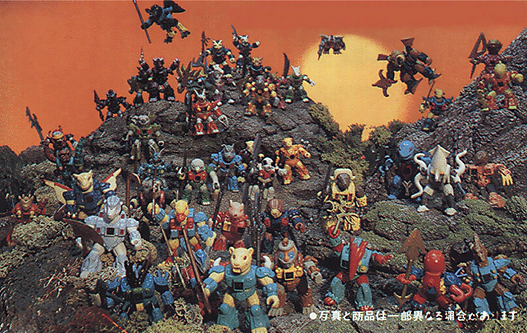
Fig. 3
Takara photoshoot featured on the insert of generation 1 figure boxes
The image above (fig. 2) can be seen on the back side of North American Battle Chariot card backs, and although it showcases all three series of Battle Beasts, Series Two and Series Three are particularly interesting when considering the aforementioned Marcia Moll figures. Simply put, I believe the Moll beasts are THE actual figures used in this card back photography, thus making them one of a kind photography samples!
What makes me so confident to raise such a bold proclamation, you may ask? Well, let's take a closer look at the photography sample figures, themselves. As mentioned before, these figures have unique weapons, but can you notice anything different about their paint applications? All five of these photography samples feature bolder, brighter, glossier paint applications, which are nearly flawless when compared to their standard production counterparts. It's likely that Hasbro afforded extra attention to detail when producing these figures because they needed them to "pop" in their various promotional appearances. In fact, these five photography samples likely appear in several of Takara's photo shoots as well. If we take a look at the photo from Takara's Beastformers generation 1 insert (fig. 3), we can see several subtle, yet important similarities to the figures in the aforementioned Battle Chariot photography. Considering most of us are here because of our shared nostalgia for this forty-year-old toy line, now might be a good time to take out those reading glasses!
Perhaps the most anomalous of the photography samples that show up in both the Hasbro and Takara photo shoots is this Runamuck Duck figure, which sports a rather unique and striking paint aberration. When compared to a garden-variety duck, this particular figure stands out due to the red paint on its chest, which covers a greater surface area than that of its production counterpart.

Photography Sample
Production Figure
Straight from the collection of a former Hasbro employee, this pre-production Zealot Zebra is one of only four known to exist. Lovingly referred to as the “Albino Zebra,” this figure boasts several features that set it apart from a standard production Zealot Zebra. Notable features include:

-
Red eyes and chest accent
-
Unpainted white ears and mane
-
Blade hand lacking a safety tip
-
Missing Hasbro/Takara maker’s mark on the right foot
-
Gray paint applied over existing purple paint

Although I’m not an expert in toy production, based on what I’ve learned from collecting Kenner Star Wars figures, I’d say this particular figure is a First Shot. First Shots are test-run figures produced from newly-created molds. They often feature unusual color schemes and typically lack a maker’s mark, which would normally include a COO, date, and copyright.
As if all that weren’t cool enough, what makes this piece especially exciting is that it may have been used in a Hasbro photo shoot! That’s right, the zebra featured on the back of the North American chariot card back has the exact same features as this Albino Zebra. Could this be the actual figure from the photo shoot? You decide!


Battle Beasts Press Kit
This is an original 1987 press kit for Hasbro's New Battle Beasts. The kit includes a glossy black-and-white photograph of "Hasbro's New Battle Beasts" and a three-page summary of the toy line, which had yet to hit store shelves. From what I understand, this press kit was handed out at a toy fair by a Hasbro distributor, as a way of promoting the new line of Series One figures.


Perhaps the most fascinating aspect of this piece is the reference to the "Starburst" symbol, which would later become the Sunburst Warrior promotion that we all know! Also, "I've got wood" has to be one of the most hilarious things to come out of this toy line, EVER!
Due to preservation concerns, I am unable to include photos of the other two pages, for fear of creasing the paper along the staple. The entire packet reads:
CATEGORY: Boys' Toys (Ages 4 and up)
THE BATTLE OF FIRE, WOOD AND WATER
Billy stared into the eyes of his adversary. Slowly, he lowered his sights to see what his opponent carried in his hand.
It was a Battle Beast™, a 2" lion with a bright orange mane and a patch over one eye. It wore a suit of blue armor, with strong, spiked shoulders. In the lion's left hand was a large, sharp sword. Billy checked his own hand. In it was his fearless blue shark, gripping its huge trident. His opponent placed a finger over the black patch on the lion's chest. Quickly, a symbol appeared — wood.
"I've got wood," his enemy said. "Come on, what've you got?" He glanced down at his shark and placed a finger on its chest. Billy closed his eyes for a moment and slowly removed his hand. "It's fire!" he cried. "Fire burns wood!"
As his opponent slinked off in defeat, Billy celebrated briefly. But not too long. Somewhere else out there there were other opponents — with other Battle Beasts. He knew it had just begun.
A NEW CONCEPT IN COLLECTABILITY
It's a jungle out there...a jungle filled with snarling tigers, sly snakes and fearsome gorillas. There are frogs elephants, alligators and more. These are the Battle Beasts. In series #1, there are 28 different Battle Beast styles. Each is 2" high, articulates at the shoulders, is fully decorated and comes with a weapon. On each Battle Beast chest is a special
liquid crystal heat-sensitive battle emblem. When touched, the battle emblem reveals the symbol for either fire, wood or water. Because each variety of Battle Beast may possess any of these symbols, there are actually 84 different character/symbol combinations available. What makes Battle Beasts something special is that they are more than objects to collect. When they do battle, they can provide hours of imagination-building fun. The battle game is a variation of the age-old paper, rocks and scissor pastime. Fire burns wood, wood floats on water and water puts out fire.
HIGH QUALITY, EXCEPTIONAL VALUE
At an approximate retail price of $2.29 - $2.59 for a blister pack of two figures, the Battle Beasts offer kids the chance to
amass armies of Battling Beasts. And, kids won't know what each beast's symbol is until they own it.
THE BATTLE BEAST LEGION GROWS
The Battle Beasts in series #1 will shortly be joined by two more multi-styled series of brave creatures. Additionally, the
months ahead will see the introduction of three Battle Beast vehicles, three Battle Beast Playsets and the Battle Beast Bandolier. All come complete with one figure and one weapon, with an approximate retail price range between $7.50 and $13.99. The Battle Beast blister cards are randomly packed. Later this year, certain Beasts will carry a "Starburst" symbol on their shields for added excitement. This is a "Wild Card" and beats all other symbols.
# ##
2/87
Beastformers Prototype Packs
Takara developed an alternate prototype packaging style for single Beastformers figures in Japan, distinct from the standard boxed releases most collectors know. These were simple blister packs that included a figure, its weapon, and a corresponding figure card, all neatly arranged in a layout that appears consistent across the few examples that have surfaced.
Beyond their basic components, very little is known about these packages. There’s no confirmed evidence that they were ever officially sold at retail, and it’s unclear whether they were test samples, early design proposals, or part of a short-lived internal plan that never moved forward. Even with their uncertain background, these blister-pack prototypes offer an interesting look at one of the packaging formats Takara may have considered during the development of the Beastformers line.

