


Premiums
Within the Beastformers collecting community, it is generally accepted that “premium” beasts constitute a distinct subset of officially released figures characterized by features that render them visibly different from their standard mainline counterparts. While these figures were produced and distributed by Takara, the designation of “premium” is an informal classification developed by collectors to better categorize and distinguish these highly sought-after Japanese exclusive variants. Seventeen premium figures have been identified in total, each utilizing the same sculpt as its corresponding mainline release. For the purposes of classification, these figures are typically organized into the following four categories: Gachapon Figures, Mail-in Promotional Figures, Punch Box Prize Figures, and Premium Set Figures.
Gachapon Figures
Few intellectual properties have escaped the clutches of Japan’s capsule-toy phenomenon known as Gachapon. Though our mighty Beastformers would fight valiantly, they too would ultimately succumb to these tiny plastic prisons!
"Ah! After ten thousand years, I'm free!"
As their name suggests, Gachapon figures were introduced into Takara’s Beastformers toy line through Bandai's Gachapon capsule machines. These “gumball” figures, as they’re more commonly called, stand apart from the mainline releases due to their unpainted finish and elegant, off-white base coloration. Moreover, these figures were produced from a softer plastic, giving them a rubbery, more pliable consistency. Takara likely chose this softer material so the figures could be easily crammed into vending machine capsules. Although there has been some confusion over the years, it is generally agreed that there are twelve Gachapon Beasts in total, all from Series One. The following twelve Gachapon Beasts represent a complete set, as there were no Series Two or Series Three releases.


Gachapon Beast Gallery


Each Gachapon figure was packed with one of two paper inserts (fig. 1-3). Perhaps the more interesting of the two inserts is the first insert (figs.1-2), as it may explain Takara's bizarre decision to offer these figures in such a neutral, unexciting base color. Furthermore, the front of this insert (fig. 2) features the same twelve Beasts that have been confirmed as Gachapon releases, lending credence to the theory that only these twelve figures were produced. We can only speculate as to whether these figures came with weapons, but it wouldn't be surprising if they were packed with random Series One weapons.

Fig. 1

Fig. 2

Fig. 3
The back side of the insert above (fig. 1) strongly implies that Gachapon beasts were actually intended to be painted by children in a "created-your-own-beast" type of activity—how cool! When translated, this insert reads something like the following:
Fight with Battle Emblem!
Heat up your Battle Emblem to see how strong your warrior is!
Marks will start to appear at around 28°C.
Fire burns wood, so fire wins.
Wood floats on water, so wood wins.
Water extinguishes fire, so water wins.
Now, let's battle your opponents!
Paint it in your favorite color, create your very own Beast Former, collect lots, and create your own original army!
Special Stone Cobrander


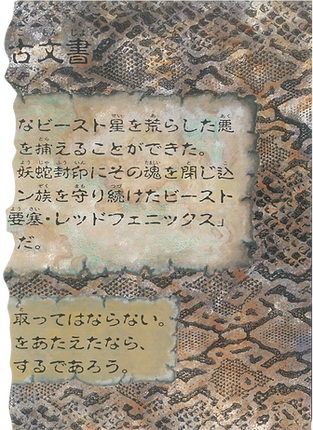
The Special Stone Cobrander (石にされた特製コブランダー), more commonly known as the “Stone Cobra,” is a Japan-exclusive premium figure that was part of a Takara mail-away promotion in 1988. It was awarded to collectors who obtained both halves of a mysterious Stone Tablet (figs. 1-2), and completed two brief questionnaires (fig. 3). These right and left tablet fragments were included in two Beastformers sets: the Burstsun Special Set (バーストサンスペシャルセット) and the Red Phoenix Set (火炎要塞レッドフェニックス), respectively. Once both fragments were collected, Japanese fans could mail them to Takara in exchange for this incredible figure! Although completing the Stone Tablet was the main gimmick behind the promotion, Takara was likely even more interested in the two surveys that had to be filled out and submitted along with the tablet. The postmark deadline for this promotion was January 31, 1988. Participants were asked to include a paltry ¥120 stamp to cover shipping for their new Stone Cobra. That was a stone-cold deal when you consider the figure's modern-day market value! A translated version of this survey can be viewed by clicking here.

In truth, we can only speculate about the total number of Stone Cobras produced during the promotion. However, the current second-hand market value of the figure suggests that production was rather limited when compared to mainline releases. After all, there's a reason this premium figure has earned "grail" status among collectors. In fact, many would argue that the Stone Cobra is the holy grail of the entire Beastformers lineup! As much as this stone-cold killer has secured a special place in my heart, the title of "holy grail" is reserved for far rarer pieces. Regardless, Let's take a look at what makes this premium figure truly special!
As its name suggests, the Stone Cobra looks like it's made from—well—stone! Sure, we have to use our imaginations a bit, but the beautiful marbling effect applied to the figure's gray base plastic really sets the stage for a petrified version of our beloved King Cobra! Through a process called hydro-dipping, figures were lowered into a liquid bath, and coated with a floating film of paint upon re-emergence. This technique creates a truly unique effect, resulting in one-of-a-kind figures. Just like stones that occur in nature, no two Stone Cobras are alike. The following Stone Cobras (fig. 4) are from my own personal collection, and collectively showcase the subtle variations from figure to figure.

Little to nothing is known about how this figure was packaged; however, we do know that it came with a small insert (fig. 5), thanking the consumer for participating in Takara's surveys. Oddly enough, the insert also issued an apology for the inconvenience of having to include a stamp. In true Japanese fashion, the stamp was actually returned! Don't you miss the good old days when toy companies actually cared about the consumer?

Fig. 3
Fig. 5
Courtesy of Forming the Beast


Fig. 1
Fig. 2
Fig. 4


The Mysterious Stone Tablet promotion as seen on the Burstsun Special Set insert
The first glimpse of what would eventually be the Special Stone Cobrander! Look at those polkadots!
Black Marble Crystal Killer Fish
Perhaps the most coveted figure in the entire Beastformers lineup is the Black Marble Crystal Killer Fish (クリスタルキラーフィッシュ 黒マーブル)(fig. 1), more commonly known as the "Striped Clear Carp". This extremely rare figure was only obtainable through the Beastformers punch box (fig. 2), and was one of the "lucky pull" items, along with the Maroon Combat Drill, Blue Combat Drill, and the standard version of Crystal Killer Fish.
Although we can't know for sure, based on today's accounts of each rare punch box item, we can deduce that some were less likely to be pulled from a punch box than others. If you were a kid who pulled a Black Marble Crystal Killer Fish in 1988, you were extremely lucky then, and are likely enjoying your early retirement today! This figure has earned a notorious reputation for being the single most expensive Beastformer on the secondary market. If you're lucky enough to encounter one, chances are that you'll be handing over a small fortune for it!

Fig. 1

The punch box itself had a cover with 24 perforated cells. This cover, which featured a depiction of the Beastformers map, could be "punched" to reveal the unknown Beastformers item inside. Each opportunity to punch through the box would cost you a whopping ¥200, which is a pretty solid deal considering the current value of premium Beastformers items!
In addition to the punch box, supplemental refill boxes (fig. 3) were also sources of the Black Marble Crystal Killer Fish and other punch box premiums. These kits allowed retailers to replenish the contents of the punch boxes once they were depleted. From what we know, refill kits were all but guaranteed to contain a Combat Drill, weapon packets, and multiples of either variant of Crystal Killer Fish (fig. 4).
Fig. 2

Fig. 3
Courtesy of Erik Braley of Toy Robot Magazine
Fig. 4
Now that we've established the origin of this premium beast, let's take a closer look at what makes it truly special. Like the Stone Cobra, the Black Marble Crystal Killer Fish figures are unique in that no two examples are alike. This is due to the fact that they too were created using the same hydro-dipping process. Essentially, a standard Crystal Killer Fish was submerged in a liquid bath, and coated with a floating layer of paint upon re-emergence. Because of the random nature of this process, there is a high degree of variation in the striping of each figure.
As if all this weren't enough to convince you that the Black Marble Crystal Killer Fish is indeed the Rolls-Royce of Beastformers, the strange mythology that surrounds it might just change your mind! In short, there's a myth that these figures were dipped in soy sauce at some point in the production process, resulting in their soy sauce-colored marbling—how ridiculous! Still, if you're interested in the urban legends of obscure Japanese toy lines from the '80s, check out this Beastformers Blog article for a good read!


Burstsun White Leo

バーストサン

サンホワイトレオ
Could there be a more iconic Battle Beast than our beloved Pirate Lion? From his mighty great sword to his cyclopean crimson gaze, this figure is truly one battle-tested beast! So how could everybody's favorite white lion get any cooler, you ask? Give him the power to crush all other beasts in battle, of course! Give him the power of the sun!
Takara/Hasbro knew they would have to innovate if they wanted to keep the Battle Beasts/Beastformers brand from fading into obscurity. Over the toy line's brief two-year reign, we saw the introduction of exciting new figures like the Laser Beasts, multiple waves of Battle Chariots, and even Transport Stations! Still, as exciting as these new offerings were, the idea of a single "all-powerful beast" would prove truly captivating!

Fig. 1
The Burstsun White Leo (バーストサンホワイトレオ) (fig. 1) was introduced exclusively in Japan in 1988 through Takara's Burstsun Special Set (バーストサンスペシャルセット) (fig. 2). This marked the first time we saw an expansion to the fire, wood, and water motif of the Beastformers brand. This new Burstsun symbol would act as a wild card, dominating the aforementioned elemental symbols in the "rock-paper-scissors" battle mechanic. Whether intentional or not, Takara suppressed the power of this omnipotent symbol by limiting the number of Burstsun figures. How exactly did they achieve this, you ask? Well, for starters, this battle emblem was exclusive to Japan, despite being promoted in the US. We'll get into the empty promise of Hasbro's Sunburst Warrior promotion shortly, but for now, let's take a look at how the emblem was offered in Japan.
The Burstsun Battle Emblem came from two primary sources: The Burstsun Special Set, and individual figure boxes with the Burstsun promotional seal (fig. 3). If you have a Burstsun White Leo in your collection, chances are that it came from the former, given that this set included a Burstsun White Leo roughly half of the time.

Fig. 2

Fig. 3

Pulling a Burstsun Battle Emblem from an individual figure box, however, was rather special because the odds of doing so weren't in your favor. Although we'll never know the exact odds, we do know that the Burstsun promotion was built on the idea that Burstsun emblems were a random reward for continuing to purchase individual boxes. These types of random pack-ins were essentially a form of gambling, incentivizing kids to keep buying figures until they got lucky. This same marketing strategy is alive and well today in the form of blind boxes and collectible card games.
Takara included the Burstsun emblems in individual figure boxes was by attaching them to a special prismatic Burstsun Warrior figure card (fig. 4). The Burstsun emblem itself was adhered to the back of this card by a single piece of tape. This gave kids the freedom to enhance whichever beast they saw fit. Oddly enough, aside from White Leo, very few other beasts have surfaced over the years sporting the Burstsun emblem. This only reinforces the idea that the Burstsun Special Set was the primary source of this powerful Battle Emblem.
Fig. 4
Courtesy of VintagetoysPDX
As alluded to previously, Hasbro also ran its own version of the Burstsun Warrior promotion; however, they adopted the more Westernized "Sunburst Warrior" moniker. In a similar fashion, Hasbro promoted the Sunburst emblem on the front and back of carded two-packs (fig. 5) and Series Three figure packs. Although these package variants claimed that "One of these beasts could be the SUNBURST WARRIOR", there has been virtually no evidence to suggest that a single Sunburst Warrior was ever found outside of Japan!


Fig. 5
Crystal Killer Fish
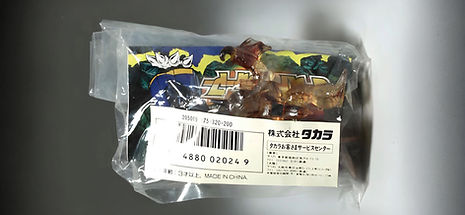
The Crystal Killer Fish (クリスタルキラーフィッシュ) (fig. 1) is a Japanese exclusive, clear- plastic variant of the standard Killer Fish figure. This striking figure came from two primary sources: the Perfect 6-Piece Set (パーフェクト6体セット) (fig.2) and the aformentioned Beastformers punch box. The punch box itself featured a cover with 24 perforated cells, which could be "punched" to reveal a mystery Beastformers item inside. Each opportunity to punch through the box cost ¥200.
Although this figure (along with the Ghost Alligatron) was manufactured in crystal-clear plastic, most examples have undergone some degree of yellowing over the years. This phenomenon is caused by oxidation, the result of UV light and heat exposure. As a result, we now see a wide range of color variation among surviving specimens. Most that exist today have taken on a rich amber tone, although it is not unheard of to find examples that remain nearly colorless. In my view, the color shift is simply an inevitable part of the figure's aging process, and collectors should place greater value on clarity and lack of occlusions rather than color alone.

Fig. 1
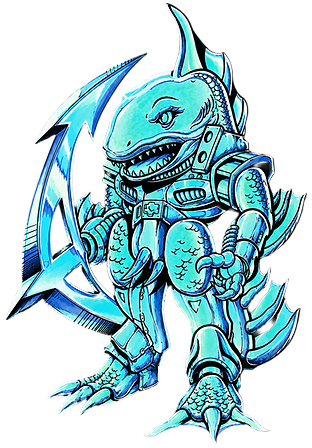
Fig. 1

Fig. 2
Ghost Alligatron
The Ghost Alligatron (アリゲトロン) (fig. 1) is a Japanese-exclusive, clear-plastic variant of the standard Alligatron (Gruesome Gator) figure. This translucent figure could only be obtained from the Burstsun Special Set (バーストサンスペシャルセット) (fig. 2). It was one of two premium figures available in the set, the other being Burstsun White Leo (バーストサンホワイトレオ). It is important to note that the Ghost Alligatron was not a guaranteed pack-in, as the Burstsun Special Set included only one of the two premium figures at random.
Although this figure (along with the Crystal Killer Fish) was molded in colorless clear plastic, most examples have developed some degree of yellowing over the years. This phenomenon is caused by oxidation resulting from UV light and heat exposure. As a result, and due to inconsistent storage conditions, there is a wide range of color variation among surviving examples. Most that exist today have taken on a beautiful amber hue, although it is not uncommon to find specimens that remain nearly colorless. In my opinion, the color shift is simply an inevitable part of the aging process, and collectors should prioritize examples that are clear and free of occlusions.

Fig. 1

"You think you're better than me?"
